
Akio Toyoda Inducted Into Automotive Hall of Fame, Cementing His Legacy Beyond Toyota

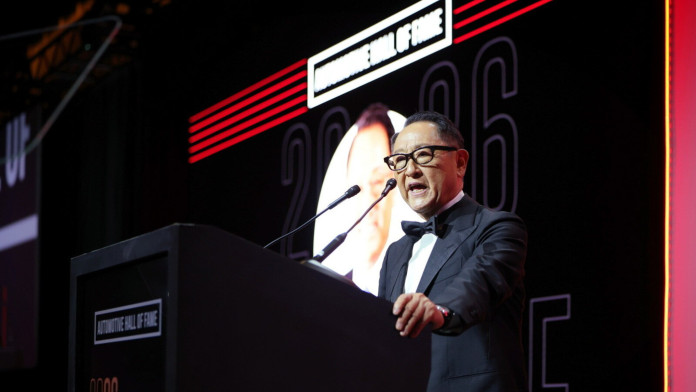
Toyota Chairman Akio Toyoda has officially joined the ranks of automotive legends after being inducted into the Automotive Hall of Fame in Detroit, recognising a career that has shaped Toyota through crisis, performance, motorsport and the industry’s transition towards electrification.
Akio Toyoda has spent much of his career at the centre of one of the world’s largest automotive manufacturers. Now, his contributions have earned him a place alongside some of the most influential names in automotive history.
Toyoda, chairman of Toyota Motor Corporation, was officially inducted into the Automotive Hall of Fame during a ceremony in Detroit, Michigan, becoming the fourth member of the Toyoda family to receive the prestigious honour.
The recognition comes more than a decade after Toyoda took the helm of Toyota during one of the most difficult periods in the company’s history — and at a time when the automotive industry itself is undergoing fundamental change.
A Toyota presidency that began with major challenges
Toyoda became president of Toyota in 2009, just as the global automotive industry was dealing with the effects of the financial crisis.
The challenges quickly intensified when Toyota faced a major recall crisis in the United States. The situation ultimately saw Toyoda testify before the US Congress as the company worked to address concerns and rebuild public confidence.
During the Automotive Hall of Fame ceremony, Greg Penske of Penske Automotive Group described Toyoda’s early presidency as a “trial by fire”, highlighting the extraordinary circumstances surrounding his arrival at the top of the company.
Rather than focusing solely on expanding Toyota’s global scale, Toyoda pushed the company towards a different philosophy — “making ever-better cars” and reconnecting the company with the people who ultimately drive them.
That philosophy would eventually become one of the defining elements of his leadership.
From “boring cars” to Toyota’s performance revival
One of Toyoda’s most visible contributions to Toyota’s modern identity has been his influence on performance and motorsport.
Before his presidency, Toyota had gradually moved away from some of its enthusiast-oriented models as the company focused heavily on products with broad market appeal.
Toyoda helped change that direction.
His well-known push for “no more boring cars” eventually contributed to the expansion of Toyota’s performance portfolio and the development of Gazoo Racing (GR) as a major part of the company’s identity.
The results can be seen in models such as the GR86, GR Yaris and GR Supra, while Toyota’s motorsport activities have continued to provide a foundation for developing performance technology.
For Toyoda, however, motorsport was never simply a boardroom exercise.
Morizo: The chairman who went racing
Away from his executive responsibilities, Toyoda became closely associated with the name Morizo, his racing alias.
He competed in motorsport events including the demanding 24 Hours of Nürburgring and developed his driving skills to the point of becoming recognised within Toyota as a Master Driver.
That personal involvement gave Toyoda a particularly unusual connection with Toyota’s performance and motorsport programmes.
Rather than simply approving enthusiast products from behind a desk, he experienced the cars from the driver’s seat and used motorsport as part of his understanding of vehicle development.
The philosophy helped create a stronger connection between Toyota’s road cars, racing programmes and enthusiast community.
Navigating Toyota through the electrification era
Toyoda’s leadership also coincided with one of the biggest technological transformations in automotive history: the shift towards electrification.
While several manufacturers increasingly committed themselves to battery-electric vehicles, Toyota promoted what it called a multi-pathway approach.
Instead of relying exclusively on one powertrain technology, Toyota continued developing a combination of hybrid, plug-in hybrid, battery-electric and hydrogen-powered vehicles.
The strategy has generated significant debate across the automotive industry, particularly as governments and manufacturers pursue different approaches to reducing vehicle emissions.
Regardless of the debate surrounding individual technologies, Toyoda’s tenure has been defined by Toyota’s decision to maintain multiple technological pathways while responding to different markets and customer requirements.
More than an award for one individual
Toyoda’s Automotive Hall of Fame induction also carries a strong family connection.
He is the fourth member of the Toyoda family to receive the honour, following his father Shoichiro Toyoda, Toyota founder Kiichiro Toyoda, and Eiji Toyoda, Kiichiro’s cousin and another major figure in Toyota’s development.
During his acceptance speech, Toyoda credited the wider Toyota organisation and the people who supported him throughout his career.
He also spoke about the emotional relationship between people and automobiles, describing cars as products capable of creating happiness, excitement and memorable experiences.
For Toyoda, that relationship appears to sit at the heart of what an automotive company should ultimately deliver.
A call for greater collaboration across the industry
Perhaps the most notable part of Toyoda’s acceptance speech was that his message extended beyond Toyota itself.
He argued that the automotive industry has an exceptional ability to improve people’s lives and suggested that manufacturers could place greater emphasis on collaboration rather than competition.
His message reflected a broader reality facing the industry.
Automakers today are simultaneously dealing with electrification, software, autonomous technology, changing consumer expectations, supply-chain challenges and increasingly complex global markets.
Against that backdrop, Toyoda’s call for the industry to work more closely together offered a message that went beyond Toyota’s own corporate interests.
A legacy still being written
Akio Toyoda’s induction into the Automotive Hall of Fame is therefore about more than his position as chairman of Toyota.
His career has included leading the company through a major crisis, rebuilding confidence, championing performance cars, participating in motorsport and guiding Toyota through the industry’s transition towards electrification.
His influence can be seen not only in Toyota’s corporate strategy, but also in the cars that have become increasingly important to enthusiasts around the world.
From GR Yaris and GR Supra to Toyota’s wider motorsport activities, the impact of the philosophy he championed continues to be visible.
And with Toyota still developing new performance, electrified and alternative-powertrain technologies, Toyoda’s automotive story is far from finished.
His Automotive Hall of Fame induction may recognise what he has accomplished so far — but the next chapter of Toyota’s journey is already underway.